
Hospital-at-Home is the future. Here's what it actually requires.
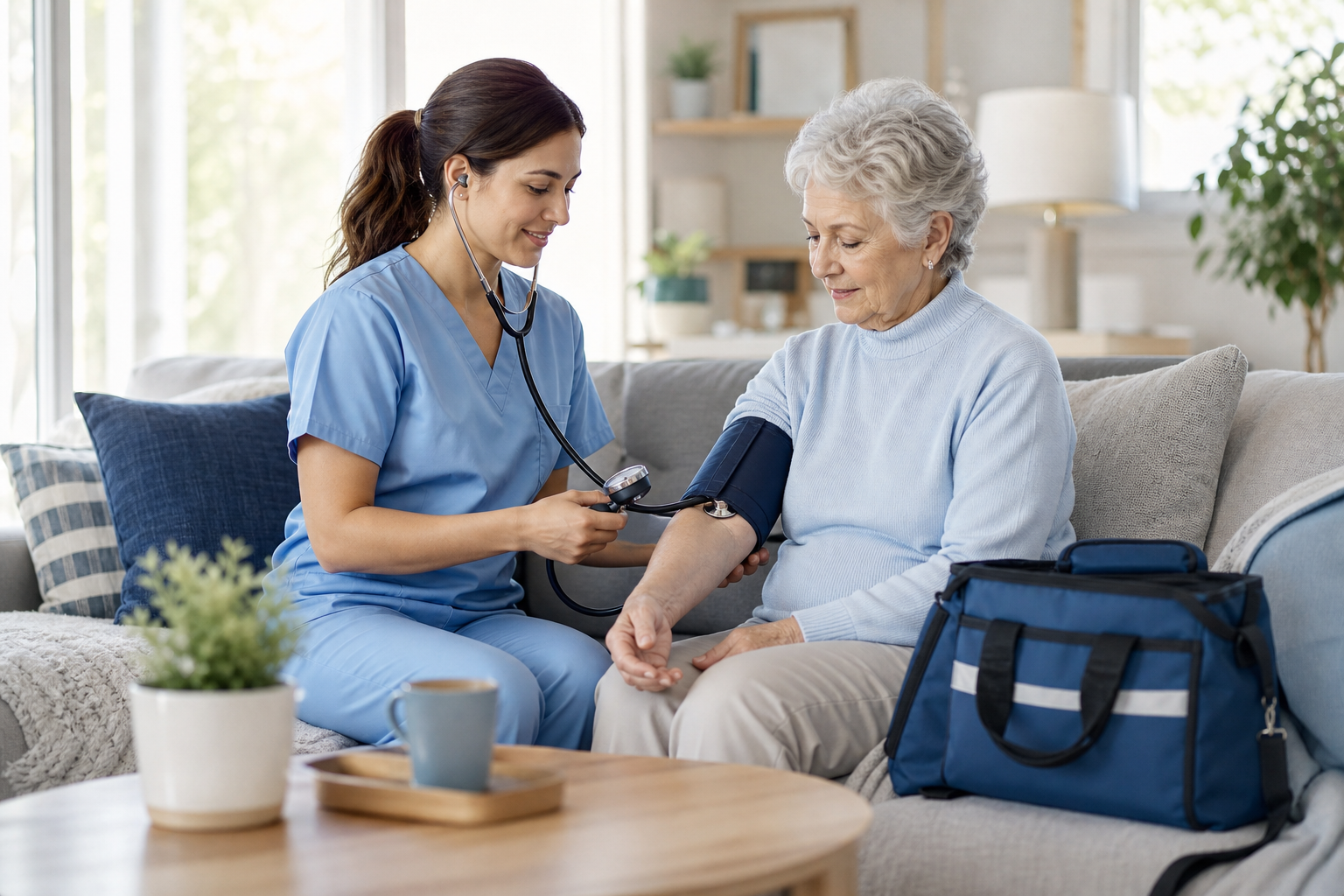
The phrase 'Hospital-at-Home' has been showing up in healthcare strategy decks for the better part of a decade. The pandemic turned it from an interesting concept into an active care model. The CMS Acute Hospital Care at Home waiver, extended several times since 2020, made it financially viable in the United States. Major health systems have launched programs. Vendor companies have sprung up. Conference panels have proliferated.
And yet most of the people talking about Hospital-at-Home don't seem to understand what it actually is.
Hospital-at-Home is not home health with a stethoscope. It is not telehealth with extra visits.
It is the actual delivery of acute hospital-level care, to a hospital-admitted patient, in the patient's own bedroom. The patient is admitted. The patient has an attending physician. The patient is billed as a DRG inpatient. The hospital is legally and clinically responsible for that patient as if they were on a medical floor.
The infrastructure required to do this safely is not the same as what runs a home health agency. Most current home care platforms cannot do it. Most hospital EMRs cannot do it either. And the gap between what the model demands and what the software offers is the reason Hospital-at-Home programs are still small and fragile.
What Hospital-at-Home actually requires
Let me walk through what a typical Hospital-at-Home admission looks like clinically, and what that means for the software.
Day 1: Admission from the ED or directly from home.
A patient with community-acquired pneumonia, decompensated heart failure, cellulitis, or COPD exacerbation is identified as a Hospital-at-Home candidate. They are admitted to the hospital, on paper and in the EMR, but transported to their own home. A nurse goes with them or meets them there. Equipment is set up: cellular-connected vitals monitoring, IV access, oxygen if needed, sometimes telemetry.
What the software needs to handle: full inpatient admission documentation, attending physician assignment, problem list, active orders, the same DRG-coded admission workflow as a floor admission. None of this is in standard home health software.
Days 1-5: Daily acute care.
A nurse visits twice a day. A physician, in person or via telehealth, rounds daily. Medications are administered, often IV. Vital signs are monitored continuously through devices. Labs are drawn at home and run at the hospital lab. Imaging is rare but possible. Mobile X-ray exists. The patient is being actively treated.
What the software needs to handle: continuous vitals streaming into the same MAR, TAR, and clinical record used at the bedside. Physician orders flowing to the home nurse in real time. Labs ordered at home and resulted into the same chart. Telehealth rounds documented as physician encounters with the same coding patterns as in-person rounds.
Daily: The acute escalation question.
Every day, the team asks: is this patient still appropriate for Hospital-at-Home, or does the patient need to be transferred to a physical hospital floor? Acute escalation is real. Patients decompensate at home. The decision criteria are clinical and ongoing.
What the software needs to handle: defined escalation pathways, ambulance dispatch coordination, real-time clinical handoff to the receiving facility, document continuity across the transfer. This is one of the hardest pieces, and most software gets it wrong.
Day 5-7: Discharge.
The patient is clinically stable. Discharge orders are written. Equipment is retrieved. The DRG bill is closed. Home health may or may not follow.
What the software needs to handle: the same discharge workflow as a hospital floor discharge, including coordination with downstream home health if applicable, and the DRG billing finalization.
"Hospital-at-Home is acute care in a bedroom. The software needs to be hospital-grade, not home-health-grade."
Why most platforms can't do this
Look at the existing software landscape:
Hospital EMRs.
Built around inpatient floors. The data model assumes the patient is in a physical bed in a physical building. The nursing workflow assumes a unit and a station. When you try to use these systems for Hospital-at-Home, you end up with workarounds: dummy beds, fake locations, manual nursing documentation. The system works, but it's clearly fighting the design.
Home Health software.
Built for skilled home health visits with OASIS assessments and PDGM billing. The data model assumes Medicare home health benefit, episodes of care, visit-based billing. It has no concept of a DRG admission, no concept of continuous nursing presence, no concept of acute IV medications or continuous monitoring.
RPM platforms (Vivify, Current Health, Cadence).
Built around remote monitoring as a standalone service. They can collect vitals and surface alerts. They typically don't handle acute medication administration, nursing workflow, or DRG billing. They are a component, not a complete acute care platform.
The honest assessment: no major existing software platform was built for Hospital-at-Home as a first-class workflow. Programs that exist today have either built custom integrations across multiple systems, or they're using a hospital EMR with significant workarounds.
How we built it
The MyNursePal Pro architecture made a deliberate choice from day one: the same platform that runs acute hospital care also runs home care. Not as two separate systems with a handoff in the middle. As one platform, one record, one continuous patient.
Hospital-at-Home falls naturally out of that architecture.
Admission flows the same way.
A Hospital-at-Home admission is created in the same admission workflow as a floor admission. The only difference is the 'location' attribute on the admission, which becomes 'home' rather than 'unit.' All downstream documentation, orders, and billing proceed identically.
Nursing documentation flows the same way.
The nurse who visits the Hospital-at-Home patient at home uses the same Nurse Mobile app, the same MAR, the same assessment templates. She documents in 'home mode' which respects offline operation, but the data lands in the same patient record the floor nurses use.
Physician workflow flows the same way.
The attending physician sees the Hospital-at-Home patient in the same patient list as floor patients. The same CPOE workflow. The same critical-result push. The same discharge order pattern.
RPM is built in.
Continuous monitoring devices integrate into the same vitals data model as in-hospital telemetry. The threshold alerts route to the same nursing workflow. The trend dashboards live in the same analytics layer.
Billing is unified.
The DRG inpatient claim is generated from the same encounter the clinical documentation belongs to. The CMS waiver location modifier is applied automatically based on the admission location. The revenue cycle module handles it without parallel workflows.
"Hospital-at-Home shouldn't require a fundamentally different platform. It should be a configuration of the same platform that runs the hospital."
Why this matters for the next decade
Hospital-at-Home is going to grow. The clinical evidence is favorable. The cost savings are real, estimated 20-30% versus traditional inpatient care, with similar or better outcomes. The patient and family preference is strong. CMS continues to extend the waiver, and commercial payers are beginning to follow.
The market opportunity in the US alone is estimated at $1.5 billion in 2026 and is projected to grow significantly through the decade. Globally, the model is even more relevant, in markets like Ghana, where hospital beds are scarce and care often happens at home by necessity, the architecture matters even more.
But the model only scales if the infrastructure exists to support it safely. Right now, most programs are small and bespoke because the software is the bottleneck. When the platform catches up, the model will catch up with it.
What we're doing
We are building MyNursePal Pro's Hospital-at-Home support as a first-class workflow within the home care arm. Pilot deployments are planned for 2026 with health system partners. We are also working with payers and regulatory partners to ensure the platform satisfies CMS waiver requirements, state licensing rules, and clinical safety standards.
This is, frankly, one of the most exciting things we are building. It is also one of the highest-stakes. Hospital-at-Home is acute care. The patients are sick. The clinical responsibility is real. The software has to be hospital-grade.
That is what we are building. That is the work.

Sylvia Abbeyquaye, PhD, MPA, RN
CEO and Founder
Writing from inside the work, healthcare, infrastructure, and the future of care.

